


Destination Trailer vs Tiny Home: Why She Chose the Trailer

Updated: Oct 3
Walk into Dana's home and you find high ceilings, a full kitchen with an island, and a king-size bedroom. Step outside and it looks like an RV. That is because it is not technically a tiny home at all. It is a destination trailer. Choosing one over a purpose-built tiny house saved Dana, a nurse of more than twenty years, tens of thousands of dollars and helped her retire early in the Southern California desert.

What Is a Destination Trailer?
A destination trailer is an RV-classified trailer meant to park and stay put, not travel often. Dana's Forest River PUMA runs about 43 feet long and 8 feet wide, and the slide-outs push the living space to about 14 feet wide where they extend. Add the loft, and there is close to another 100 square feet up top.
Here is the quirk she explains best: to be classified as a tiny home, a structure has to be 400 square feet. Dana's has more usable room than that, but because the extra space comes from slides that are not touching the floor and a loft that goes upward, it does not count, so it stays an RV on paper. More house than a tiny home, technically not one.
Why She Chose It Over a Tiny Home
Dana started out looking for a proper tiny home. She toured several, thought they were cute, and then saw the prices, which were close to $150,000. When she spotted the destination trailers at an RV lot, she could not believe how much bigger and how much cheaper they were. She paid about $80,000 out the door, warranty included.
She has heard the pushback, that an RV will not be as sturdy as a built tiny home, and she is honest about it. But as she sees it, the $20,000 to $30,000 she saved is a comfortable cushion for any repairs a trailer might ever need. For her, the math and the space both pointed the same way.
A Kitchen and Living Room That Don't Feel Tiny
The first thing that sold her was the openness. A full four-burner range and oven, a nearly full-size refrigerator, a built-in microwave, real cabinet space, and a sink with an island. What she noticed touring tiny homes was that the kitchens were often jammed onto one wall. Here the space flows: cook, plate, and move to the table or the recliner without stepping over anything.
The slide-outs are what make it work. On the living side, the extra few feet is exactly what lets a full dining table for four and the recliners fit. Windows everywhere keep it bright, which matters to someone who planned to spend real time relaxing at home.


A Real Bedroom, No Loft to Climb
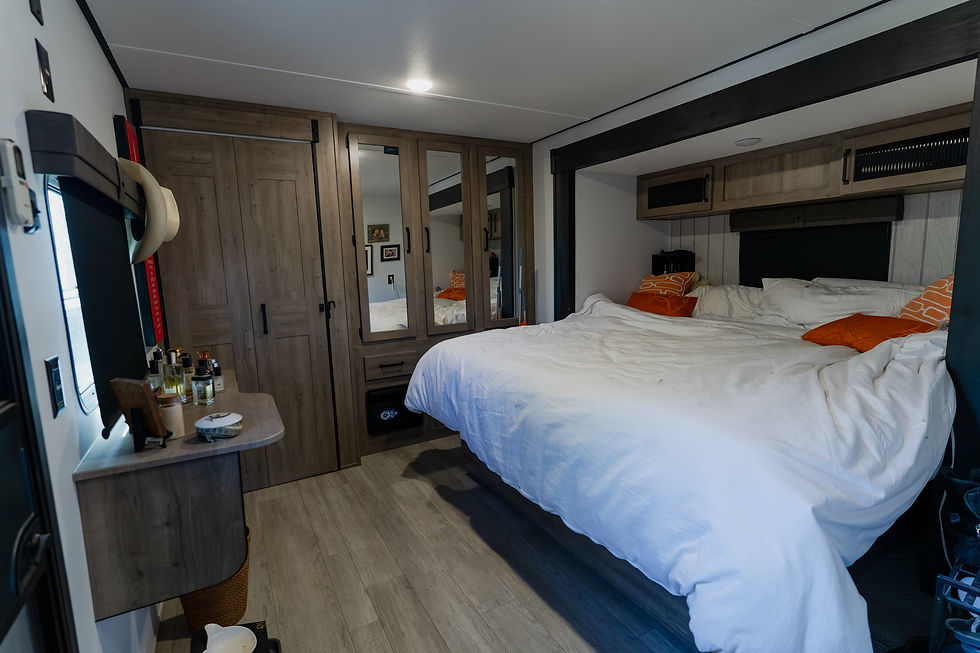
This was a dealbreaker turned selling point. Many tiny homes put the only bedroom up in a loft, and Dana did not want to climb stairs every time she needed the bathroom at night. Her destination trailer has a full downstairs bedroom with a king-size bed, which she was thrilled to find, since few small homes fit a king. There is generous closet space, a vanity by a window, storage under the bed, and, crucially to her, a real washer and dryer.
The loft up top is a bonus rather than a necessity. It came with two twin beds; she keeps one made up for guests (and says it is surprisingly comfortable) and uses the rest for the storage she worried about losing when she downsized.
What It Costs to Live There
The monthly math is the part Dana loves. Her lot rent started at $495 a month, and she notes spots with mountain views can run up to $695. Utilities are a flat $300, all-inclusive, so she can run her AC nonstop through a desert summer without watching the meter. All in, she is around $800 a month for lot and utilities together. For comparison, she points out, a studio apartment down in Palm Springs runs over $2,000, and that is before utilities.
Finding a Place to Park It
The home was the easy part. Placement took about two years of research. Tiny home communities were scarce, and several she found were all the way across the country on the East Coast, too far from Portland, where she was living. Then the Paradise community in the Southern California desert popped up in one of her searches. It was already set up for tiny living and allowed destination trailers, so parking was no longer a problem. Plus, she loved the desert. She moved in September 2025.
Retiring Early and Living Light
Dana spent more than twenty years as an RN, and she knew she wanted out early. Downsizing was how she got there. Clearing a mortgage and cutting her housing cost to a few hundred dollars a month meant she did not need to keep working, or keep earning what she used to. "I don't need that much anymore," she says, "cuz I got my tiny place." These days that buys her time by the pool, hikes in the desert, and mornings without an alarm or, as she puts it, the anxiety of having to be anywhere. "Retirement is absolutely perfect."
Her Advice
For anyone sitting in a big house wondering how to make the jump, Dana's advice is practical. If you can, sell the house first, rent something cheap or stay with a friend for a bit, and pay cash for your place. If paying cash isn't an option, she found it far easier to finance a destination trailer than a traditional home. She financed hers through the RV dealer for six months, then paid it off the moment her Portland house sold.
FAQ
What is a destination trailer? A destination trailer is an RV-classified trailer built to sit in one spot rather than travel often. Dana's Forest River PUMA is about 43 feet long and 8 feet wide, with slide-outs that widen the living space to about 14 feet, plus a loft. It offers more room than many tiny homes, but because that extra space comes from slides and a loft rather than floor area, it is not technically classified as a tiny home.
Is a destination trailer cheaper than a tiny home? It was for Dana. She paid about $80,000 out the door, including a warranty, while the tiny homes she toured ran close to $150,000. She figured the $20,000 to $30,000 she saved could cover any repairs a trailer might need down the road.
Can you live in a destination trailer full-time? Yes. Dana lives in hers full-time in a Southern California tiny home community that allows destination trailers. It has a full kitchen, a downstairs king-size bedroom, a washer and dryer, and a loft for guests and storage, so it functions like a small house rather than a camper.
How much does it cost to live in a destination trailer community? Dana's lot rent is $495 a month (spots with mountain views run up to $695), plus $300 for all-inclusive utilities, so about $800 a month total including water, electricity, and sewer. She points out that a studio apartment in nearby Palm Springs runs over $2,000 and does not include utilities.
Destination trailer vs tiny home: which should you choose? It depends on your priorities. Dana chose a destination trailer for more open space, a lower price, easier financing, and, importantly, an easier time finding somewhere to park it, since her community allows both. A purpose-built tiny home may be sturdier and more customizable. Both can work for full-time living, so weigh cost, space, and where you can legally place it.
Community: https://bit.ly/45cXYos
Join the Tiny Home Tours newsletter for one real story like this every week: https://bit.ly/THT-Newsletter
More Tiny Home Tours to Explore
Doing the rent-versus-own math yourself? Here is the honest breakdown: Tiny Home vs Apartment: The Real Cost and Lifestyle Comparison
Curious what tiny homes actually cost across the board? How Much Does a Tiny Home Cost? 5 Real Homeowner Budgets


Comments