


School Bus Conversion: What They Would Change After 7 Years

Updated: 1 day ago
Cora and Jose thought they were signing up for two or three years of bus life. Seven years later, they're still living in that school bus conversion, and they have at least ten more years planned before they reach Argentina. The idea started while they were living in China, when Jose suggested driving the length of the Americas in a school bus. They eventually landed in Florida, found a seller in Broward County with a lot full of buses, and chose the one that would become their home. After seven years of actually living in their school bus conversion, they know exactly what worked, what didn't, and what they'd do all over again.

At a glance
Bus: a 2001 International Thomas built, about 200 square feet, bought for $6,500
Build: finished in 2019 for about $29,000, done by the couple with help from Jose's brother, a carpenter
Power: 500 amp hours of lithium and 1 kilowatt of solar, upgraded from 300 amp hours and 500 watts
Water: 80 gallons, lasting 10 to 14 days
On the road: seven years, with Ushuaia, Argentina as the destination
Why They Picked This Bus
Before they started looking, Cora and Jose knew they wanted something between 30 and 35 feet. Big enough to feel comfortable, but not so big that it would be difficult to drive and travel in. They only had to look at two buses before they found the one.
One of the biggest selling points was the completely flat floor. There were no wheel wells to work around, which they knew would make the conversion much easier. The ceiling height ended up being another win. It was already tall enough that they could skip a roof raise altogether, saving them months of extra work.
Want a new tour in your inbox every week? Join the Tiny Home Tours newsletter for a new home every week.
What the School Bus Conversion Cost
They went to the lot with a budget between $3,500 and $7,000 and bought the bus for $6,500. The conversion was finished in 2019 at about $29,000, with Jose's brother, a professional carpenter, doing the hardest joinery, including the curved cabinet faces that define the kitchen.
Jose is clear that the help is the part most people will not have. "We were really lucky to have someone who's very knowledgeable about all this," he says, compared with people who lack the tools or the know-how.
The build number is not the whole number. They have put about $13,500 more into the conversion since, including a solar and battery upgrade between $5,000 and $6,000. (For comparison across home types, our tiny home cost guide collects five real budgets.)
A Living Room That Does Four Jobs
The front of the bus is one space that changes shape. It is Jose's editing station, with a color calibrated monitor on an arm he swings into place and pushes away when he is done, and he can work standing when his back needs it.
The same bench is a dining table that seats up to ten with a folding table in the middle, a single bed, and a second couch facing the first. The main couch converts to a double bed on a piano hinge, and getting its cushion dimensions right was the hardest part of the build. Jose's brother talked them out of a lift-up storage lid and into drawers underneath, which they are still glad about.

A Kitchen Built for Cooking Every Day
Jose has cooked since he was 13 and cooks two or three times a day, so the galley got the most thought. Everything sits within reach of one spot. "I can just dance around here," he says, and he finds full-size kitchens harder to work in now.
The stove is the detail worth stealing. They bought an RV stove first, on the logic that it would be built for vibration, and it arrived bent and broken. They returned it and fitted a four burner apartment range, which gave them an extra burner, an oven for Cora's bread, and propane cooking that does not draw down a battery bank that was never large. The fridge is a used absorption unit from an old RV, efficient on gas and less so on electricity, and one of the things they would upgrade.

The Studio That Is Also the Bedroom
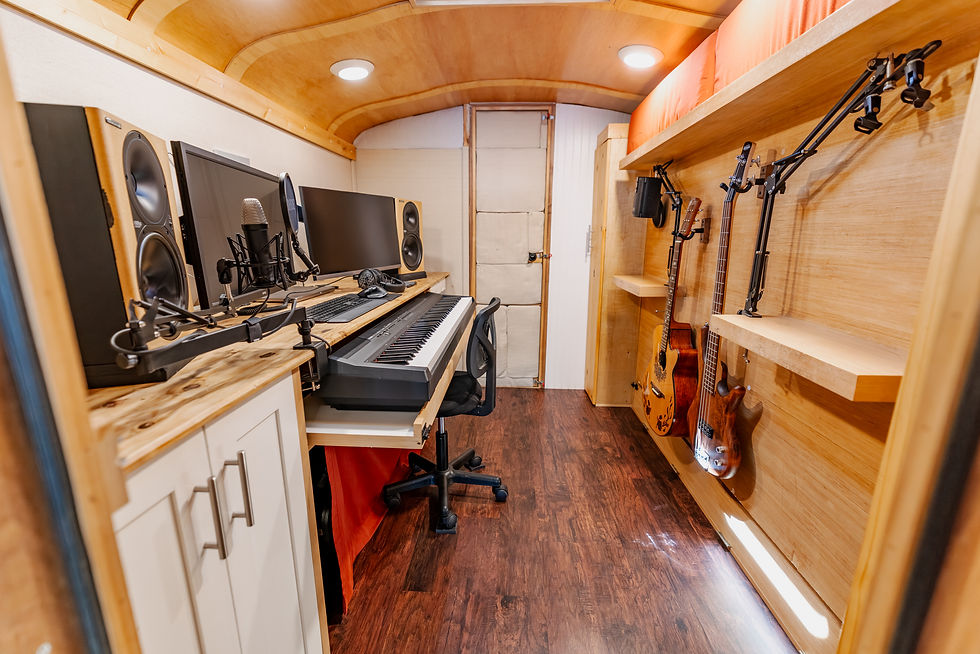
Cora has been writing and recording for 25 years, and a home studio was the one thing she would not give up. The back room is soundproofed well enough to record albums, voiceovers and other musicians, unless there is an airport or a train nearby.
It converts for travel. The piano locks into place, monitors fold down, instruments go into cases below, and everything gets ratchet strapped. Then a Murphy bed folds down out of the wall over the whole thing, a standard full size, in a room that blacks out completely. "It is like sleeping in a sound deprivation chamber."
Power, Water, and the View From the Bathroom
They started with 300 amp hours of batteries and 500 watts of solar, found it tight, and moved to 500 amp hours of lithium and a full kilowatt on the roof for somewhere between $5,000 and $6,000.
Water has been easier than expected. Eighty gallons lasts 10 to 14 days, most of it going to dishes, and they refill at gas stations, dump stations, RV parks and friends' houses. The bathroom has a composting toilet, a 24 by 24 inch shower pan, and one deliberate luxury. The bus came with two push-out emergency windows, and they moved one into the bathroom. Cora calls it the best seat in the house.
Six Things They Would Change
Seven years is long enough to produce a specific list.
A bigger sink. Jose cooks three times a day, Cora washes up, and theirs is half the size of what they see in other buses.
Drawers in the pantry. The storage runs to the edge of the bus, which is great, and finding anything at the back means digging.
Safety wire across the shelves, which they added later after a bag of beans and then a bag of rice went across the whole bus. "We were finding grains of rice everywhere for years."
A lighter bed frame. The current one is beautiful and takes two people to raise and lower every day.
A lower-flow shower head. Theirs uses three gallons a minute, which is a lot against an 80 gallon tank.
A newer fridge, since the used absorption unit is thirsty on electricity, though it has run flawlessly for seven years.

The door to the studio still is not painted. Cora expects it to get finished in the last year of the trip. (More storage ideas from homes we have toured are in our roundup.)
What It Actually Costs to Keep Moving
This is where a bus differs from a tiny home on a lot. Their monthly cost swings between about $3,000 and $8,000, and they are direct about why. The bus drinks diesel, so the more they move, the more it costs. Engine trouble does the rest. Since 2019 they have spent roughly $38,000 on the engine, tires and brakes.
"Not everybody is that unlucky," Cora says, "but you have to take that into account." Everything else is ordinary, groceries, propane, a phone and Starlink. They pay for it with their YouTube channel, murals, music and a Patreon community. Anyone pricing bus life against a fixed home should price the vehicle separately from the house, because they are two different budgets in one object. (For the fixed-lot version of bus living, see Louis and Traci Lee's school bus home.)
Ten More Years to Argentina
They tow a Jeep, because filming takes them places a bus cannot go. Asked what she would tell herself at the start, Cora does not hesitate. "Don't worry, it's all going to work out. You're going to go through so many stressful moments. It's going to be really overwhelming at times, but it's going to be bookended with so many beautiful moments."
Seven years in, they credit the time they spent on the design. Next is Central America, then South America, then Ushuaia at the bottom of Argentina.
FAQ
How much does a school bus conversion cost?
Cora and Jose bought their bus for $6,500 and finished the conversion in 2019 for about $29,000, doing the work themselves with help from a carpenter in the family. They have put about $13,500 more into the conversion since, including a solar and battery upgrade between $5,000 and $6,000, plus about $38,000 on the engine, tires and brakes.
What size school bus is best for a conversion?
They looked for a bus between 30 and 35 feet, long enough to feel open without being unwieldy. Two features mattered more than length. A completely flat floor with no wheel wells made the build far simpler, and enough factory headroom meant they never had to raise the roof.
How much water does a bus conversion need?
They carry 80 gallons of fresh water, which lasts them 10 to 14 days depending on how often they shower. Most of it goes to washing dishes. Finding water turned out to be easier than they expected, from gas stations, dump stations, RV parks and friends.
What do people regret about a school bus conversion?
Theirs is a short list after seven years: a sink too small for daily cooking, a pantry built without drawers, a bed frame heavy enough to need two people, a shower head that uses three gallons a minute, and an older absorption fridge that is thirsty on electricity.
Can you work full time from a school bus?
Both of them do. Jose edits photos and video at a station in the living room with a monitor on an adjustable arm, and Cora records music and voiceovers in a soundproofed studio at the back of the bus that doubles as their bedroom, with a Murphy bed that folds down over the instruments.
Follow Cora and Jose:
YouTube: @artwethereyet
Instagram: @art_we_there_yet
Want a new tour in your inbox every week? Join the Tiny Home Tours newsletter for a new home every week.


Comments